




A strategy memo is built to be read alone and in full. A leadership deck is built for a room working through the same argument together, at one pace, with someone answering questions live. Same reasoning, different constraints — so the conversion is an editorial decision, not a formatting one.
Build the deck from the memo’s argument rather than its section order: one slide per claim the room has to accept, evidence attached to that claim, rejected alternatives kept visible. Everything else becomes appendix or pre-read.
Why a good memo resists being sliced
Amazon's 2017 shareholder letter describes the memo standard directly: "We don't do PowerPoint (or any other slide-oriented) presentations at Amazon. Instead, we write narratively structured six-page memos." The letter also notes how long that work takes — a high-standards six-page memo "might take a week or more" and is "written and re-written, shared with colleagues who are asked to improve the work, set aside for a couple of days, and then edited again with a fresh mind."
That week goes into connective tissue: the qualification in the third sentence, the concession before the recommendation, the reason a tempting option was dropped. Chop the document into per-section slides and the connective tissue is exactly what falls out, leaving headings that name topics and bullets that restate them. The opposite failure is just as common — the memo gets pasted in whole, and the room reads twelve slides of body text while the presenter narrates something else.
Number the memo before you touch a slide
Number every paragraph — M1, M2, M3 — and tag each one: situation, diagnosis, recommendation, alternative, evidence, risk, ask, or detail.
Paragraphs tagged detail are appendix material, and you know it before spending time on layout. A tag that appears zero times is a hole in the argument, not in the deck: a memo with no alternative paragraphs has not defended its recommendation, and the room will find that gap whatever you put on the slide.
Keep the numbers. Every slide carries the source tag of the paragraphs it came from, so "where did this claim come from?" gets an answer in one step.
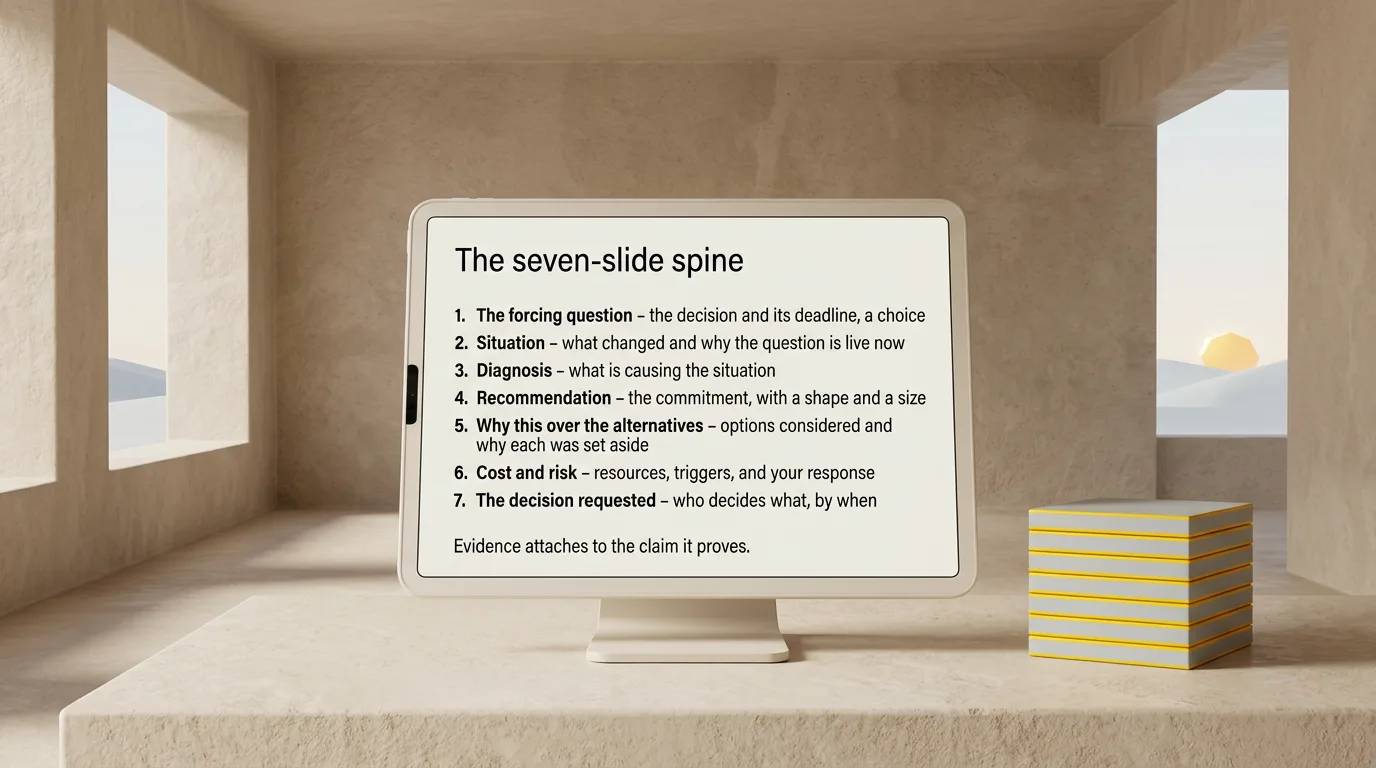
The seven-slide spine
The memo's section order is written for a reader who can re-read. The deck's order is written for a room that gets one pass:
- The forcing question. The decision on the table and its deadline. One sentence, stated as a choice.
- Situation. What changed in the market, the numbers, or the business that makes the question live now.
- Diagnosis. What is causing the situation. Most decks skip this slide, and it usually decides whether the recommendation lands.
- Recommendation. The proposed course of action, stated as a commitment with a shape and a size.
- Why this over the alternatives. The serious options considered, and the specific reason each was set aside.
- What it costs and what could break it. Resources required, risks with their triggers, and your response if a trigger fires.
- The decision requested. Who decides what, by when, and what proceeds in the meantime.
Evidence gets no block of its own. It attaches to the slide whose claim it supports — the diagnosis chart on the diagnosis slide, the unit-economics table under the recommendation. Evidence gathered onto a "data" slide loses the claim it was proving.
A worked conversion
A paragraph from a hypothetical memo on enterprise expansion:
M7. Self-serve signups grew 4% last quarter against a 15% plan, while enterprise pipeline grew 60% off a small base. Sales attributes the shift to buyers consolidating vendors, and our own win/loss notes support that: in six of nine losses this quarter the buyer named an incumbent suite rather than a competing point tool. This is not a conversion problem in the funnel. Our category is consolidating and we are being bought around.
Tag: diagnosis, with embedded evidence. It becomes one slide.
Slide title: "We are losing to suite consolidation, not to funnel conversion." Body: the two growth figures side by side, the 6-of-9 win/loss finding, and where that finding came from. Source tag: M7.
Three details survived that a mechanical split would have lost. The title carries the claim, so a reader who scrolls past still gets the argument — Microsoft's PowerPoint accessibility guidance recommends unique, descriptive slide titles for navigation, and the same habit does argumentative work here. The negative claim ("not a conversion problem") stayed, because that sentence redirects the room. And the small base behind the 60% stayed, because dropping it would make the number mean something the memo did not say. If you are deleting a qualifier to make a slide fit, you are editing the argument, not the layout.
The traceability table
Keep a mapping table alongside the deck while you build. It fits on one page and makes review fast:
| Slide | Slide title (claim) | Source paragraphs | Tag | Evidence on slide |
|---|---|---|---|---|
| 1 | Approve the enterprise motion by Nov 15 | M1 | Ask | Deadline only |
| 2 | Self-serve growth stalled while enterprise pipeline tripled | M4–M5 | Situation | Two growth figures |
| 3 | We are losing to suite consolidation | M7 | Diagnosis | Win/loss, 6 of 9 |
| 4 | Build the enterprise motion around three anchor accounts | M9–M11 | Recommendation | Cost and headcount |
| 5 | Two alternatives, both rejected on time-to-revenue | M12–M14 | Alternative | Comparison table |
| 6 | The bet fails if anchor accounts do not close by Q2 | M16 | Risk | Trigger and response |
| 7 | Decision, owner, date | M18 | Ask | None |
Read the middle column top to bottom. If it reads as a continuous argument, the deck works. If it reads as a table of contents — "Market", "Options", "Costs" — the titles are still naming topics, and rewriting each heading as a claim is the fix. The right-hand column catches a different problem: a chart that proves nothing on its slide, or a claim with no evidence anywhere in the memo.
What stays behind
Reasoning the room does not need to walk through. Methodology, the derivation of a forecast, the full competitive scan. These go to an appendix, indexed by memo paragraph so you can jump to them when asked. When the underlying material is a study rather than an operational read, the same rule applies as when you present research findings: the finding leads, the method waits to be asked for.
Everything the memo says twice. Memos repeat deliberately, because a reader arrives at the recommendation several pages after the diagnosis. A deck does not need the reminder.
Anything that is really a different deck. A resourcing request large enough to need its own case has outgrown the strategy discussion and belongs in a proposal structure of its own. If the memo reports where committed work stands rather than proposing a new direction, it is an executive update and takes a different shape.
Send the memo as the pre-read. The deck does not have to carry what the document already carries — it has to get a room to a decision, with the document one click away.
Build it in order
- Number and tag every paragraph, in the document, before any slide exists.
- Write the forcing question. If you cannot state a choice and a date in one sentence, the memo is not ready to present.
- Draft the seven titles as claims, attach source paragraphs to each, and fill the mapping table.
- Reorder the source text to match the deck order before you generate anything. Order fixed in the text is order fixed in the deck.
- Generate the slides, then read only the titles end to end.
- Edit content and sequence first, layout second. Layout built on a wrong sequence gets thrown away.
Strategy decks with a planning horizon — commitments in now, next, and later — need one more pass on sequencing, covered in how to build a roadmap presentation leaders can use. If the memo itself grew out of a long written report, extract findings and implications first and tag the memo that comes out of it.
Paste the memo, keep the argument
Steps 1 through 4 are the work only you can do: you know which claim carries the decision and which qualifier cannot be dropped. Generation is mechanical — splitting the text, choosing compositions, aligning elements, keeping typography consistent across twenty slides.
Plainline takes the reordered memo, splits it into slides, identifies which parts are claims, numbers, quotes, or conclusions, and applies consistent layouts. After generation you edit the content, slide order, semantic blocks, layout variants, and media, then preview, share, or export. Source text and presentations are encrypted before storage and are not used to train models.
Paste the memo once the tags are on it and the order matches the spine.
Frequently asked questions
How long should a leadership deck built from a strategy memo be?
Seven to ten slides in the main sequence, with the appendix carrying whatever the memo needed and the room does not. Length follows the number of claims that must be accepted for the decision to go through, not the length of the source. A six-page memo and a twenty-page memo can produce the same deck.
Should I send the memo before the meeting or present the deck cold?
Send it. An audience that has read the argument spends the meeting on the decision instead of on comprehension, and the deck becomes the shared reference during discussion rather than a way to teach the argument from scratch.
What if my memo has no alternatives section?
Write one before building the deck. A recommendation that names no rejected options reads as the only idea anyone had, and the first question in the room will be the option you did not mention. Two or three serious alternatives with a specific reason for setting each aside is enough.
Can the same deck work for the board and for the team executing it?
No. The board deck stops at the decision and its risks; the execution deck starts after the decision and covers sequencing, owners, and dependencies. They share the diagnosis and recommendation slides and diverge after that. Build the leadership version first — the execution version inherits its framing.
Where does the traceability table itself go?
It stays with you, not in the deck. Its use is review: a reader can check any claim against its source paragraph in one step, and you can see which slides have no evidence and which memo paragraphs never made it anywhere.
Sources
- 2017 Letter to Shareholders — Amazon (Jeff Bezos)
- Make your PowerPoint presentations accessible to people with disabilities — Microsoft Support