




Turning a document into a presentation starts with one editorial decision: what does the audience need from each slide? Answer that first, map each claim to a slide title, and generate from the map. Copying paragraphs into text boxes delays the decision and creates layout work before the story is clear.
Map each claim, piece of evidence, and decision from the document to the deck. AI can propose slide boundaries and layouts; the author checks the meaning, evidence, and emphasis against the source.
This guide covers a finished file: a Word document, a Google Doc, or a PDF, with its headings, tables, and footnotes already in place. When the source is pasted prose or any other raw text, start from the general workflow in how to turn text into a presentation and come back here for the file-specific steps.
Editable slides are slides whose content keeps its structure after generation: text stays text, a table stays a table, and layout is a property you change rather than a picture you redraw. The opposite is a flattened deck, where every slide is an image and the smallest correction means rebuilding it.
Five steps take a document to a deck:
- Decide what the audience must do with the deck, and prepare the source around that.
- Get the source into plain text, running scanned pages through text recognition first.
- Build a slide map — one message title per claim, with its evidence attached.
- Generate the structure from the map, then polish layouts.
- Review in five passes and inspect the exported file.
Manual copy and paste creates layout work
With a blank deck, the author copies a paragraph, shortens it, chooses a layout, and repeats. That may work for a few slides. In a longer report, the deck’s structure soon becomes hard to track.
A source-led workflow makes the content decisions before layout:
| Decision | Manual copy and paste | Source-led workflow |
|---|---|---|
| Starting unit | Paragraph or selected text | Claim, evidence, comparison, quote, or decision |
| Slide boundary | Chosen while filling a layout | Chosen from the argument and audience need |
| Revisions | Updated across separate text boxes | Checked against one source and its slide map |
| Visual work | Begins before the story is settled | Follows the content structure |
| Author control | Object placement and formatting | Meaning, order, emphasis, and final edits |
Both routes preserve weaknesses in the source. A document without a clear conclusion or supporting evidence produces a deck with the same gaps.
Prepare the source around the deck’s decision
Remove material the audience will not need during the presentation. Keep figures, units, dates, definitions, qualifiers, and references. Move supporting examples to speaker notes when the slide works without them.
Write a short conversion brief:
Audience:
Decision or outcome:
Core message:
Evidence to preserve:
Required context:
Requested action:
Give the source a visible hierarchy. Use headings for major sections, label evidence, and separate recommendations from the facts behind them. In recurring reports, keep section names consistent across editions.
Remove errors introduced by the source format: duplicate headers, page furniture, and broken PDF line wraps. Check that copied tables retain their row and column labels, and keep the source name beside each number that needs attribution.
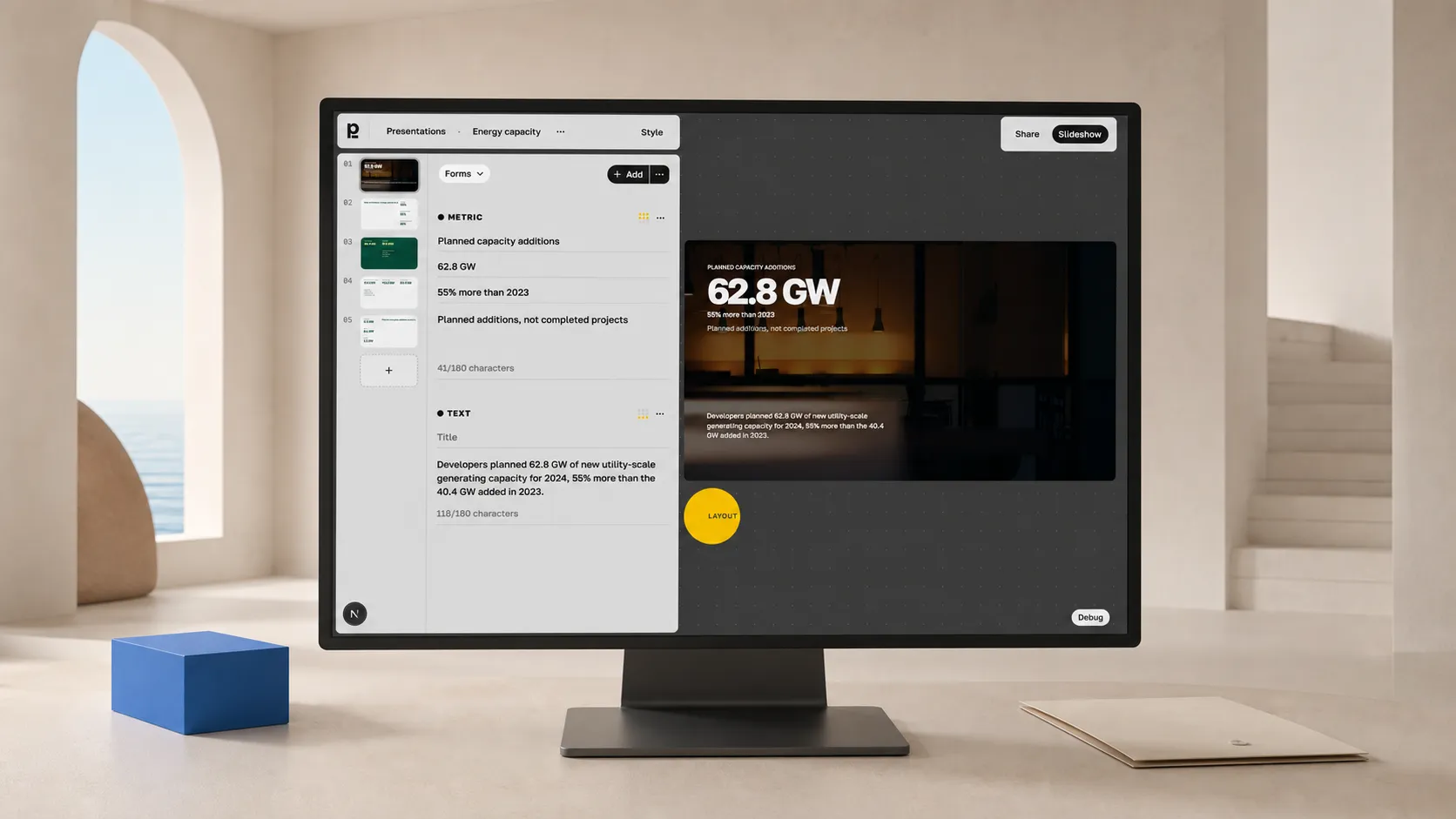
Plainline currently accepts pasted source text
Plainline’s generation workflow starts with source text pasted into the editor. It accepts reports, memos, outlines, notes, and document excerpts. Direct .docx and .pdf ingestion is outside the workflow described here.
Copy the relevant text from a Word document or Google Doc. After pasting text from a PDF, inspect its headings, tables, and footnotes. A scanned PDF contains image data until optical character recognition adds selectable text. Adobe’s OCR guidance for scanned PDFs recommends checking the result for recognition errors.
Plainline turns the pasted text into editable slides and exports the deck as a PPTX. Images and other media can be added or replaced after generation.
Build a slide map before choosing layouts
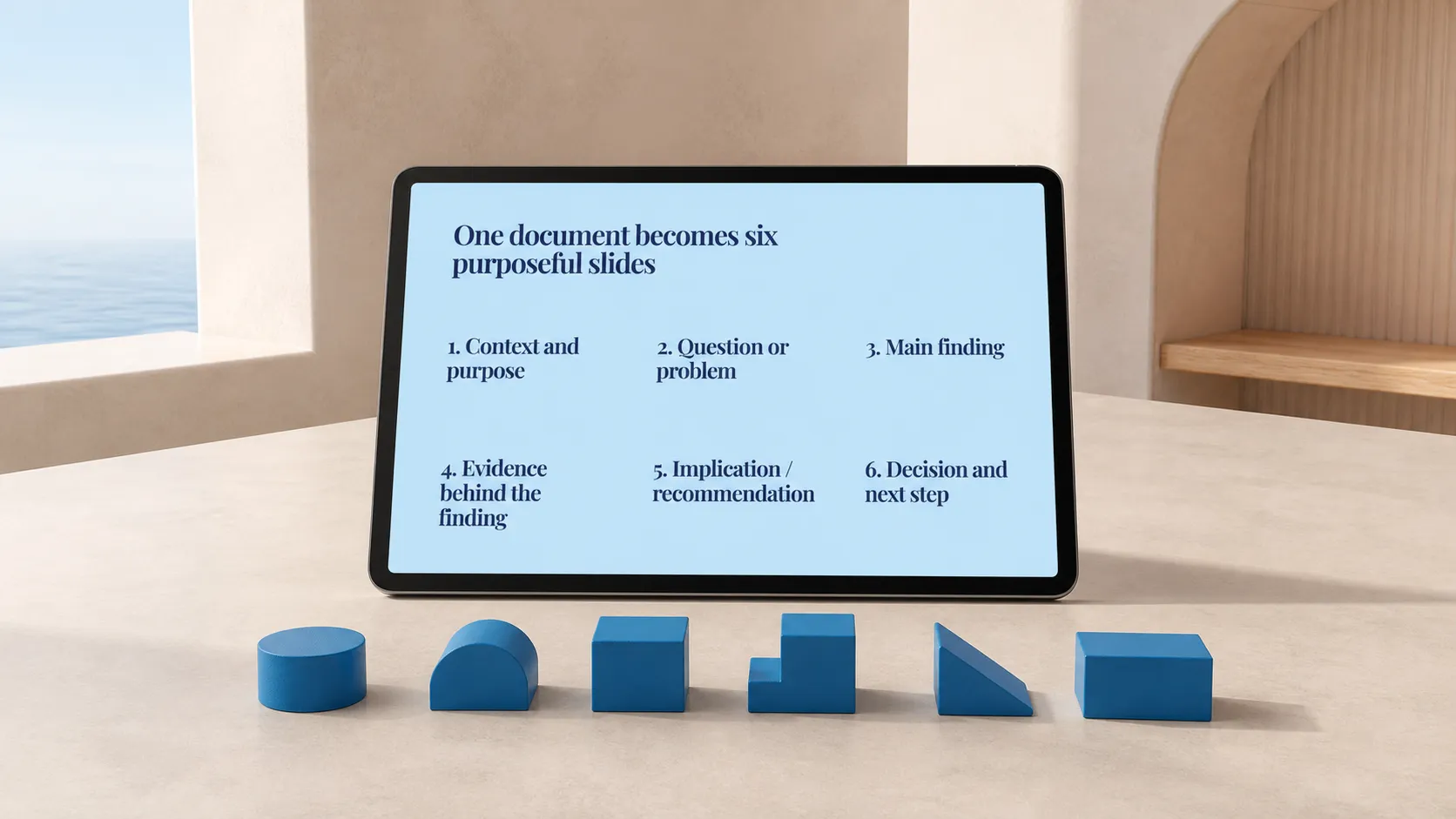
A slide map gives each slide one job, so a long document does not become a page-by-page deck with no presentation arc.
A report or memo might use this sequence:
- Context and purpose
- Question or problem
- Main finding
- Evidence behind the finding
- Implication or recommendation
- Decision and next step
The sequence can repeat for several findings. Comparison slides expose differences, evidence slides support claims, and a summary gathers decisions without opening another branch of analysis.
When the source supports a conclusion, put it in the title. “Activation fell after the signup change” tells the audience more than “Activation analysis.” Use a neutral topic title when the evidence does not justify a claim.
Unique, descriptive titles also help screen-reader users navigate a deck. Microsoft includes them in its PowerPoint accessibility guidance. Read the titles in order: the argument should make sense without opening every slide.
Generate the structure before polishing the deck
Paste the prepared source into Plainline and generate a first deck. Plainline identifies metrics, quotations, comparisons, and evidence blocks, then splits them across editable layouts from its design system.
Review the story before adjusting colors or images. Move any out-of-order slide, split crowded slides, and merge repeated points. Check the source when a title overstates a claim or loses a qualifier.
The author can change layout variants, media, slide order, and block visibility. Plainline uses controlled, grid-based layouts. Arbitrary coordinates or pixel-level composition require a free-canvas editor.
A Word outline provides a manual route to PowerPoint
Desktop PowerPoint can import a structured Word outline. Microsoft maps Heading 1 text to slide titles and Heading 2 text to bullets. The import accepts .docx, .rtf, or .txt outlines, subject to platform-specific details. PowerPoint for the web does not support it. Microsoft documents the process in its guide to creating a presentation from an outline.
Outline import suits a document that already reads like a deck outline. It creates editable slides and avoids repeated pasting, though the author still chooses the slide boundaries, shortens the text, and maintains the layout.
A document-to-presentation AI proposes slide boundaries and compositions. Outline import transfers the hierarchy already present in the document.
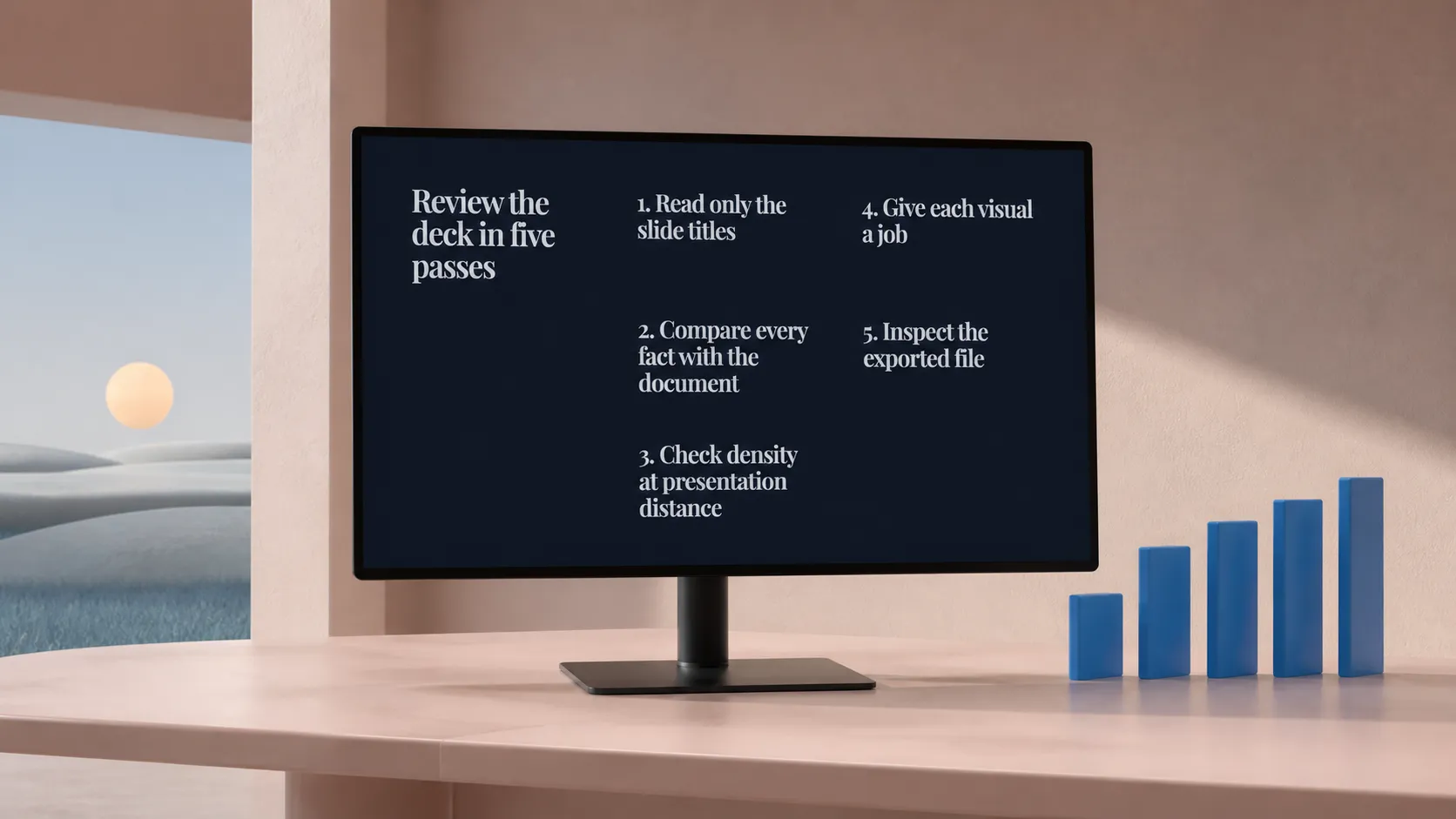
Review the presentation in five passes
1. Read only the slide titles
Each title should advance the story, and the final decision should follow from the evidence. Turn a topic label into a claim only when the source supports it.
2. Compare every fact with the document
Check numbers, dates, units, names, and quotations. Restore qualifiers that affect interpretation, and retain source labels on evidence the audience may challenge.
3. Check density at presentation distance
Split slides that require paragraph reading. Shorten labels before reducing the type size. If the claim stands without the supporting detail, move that detail to another slide or to speaker notes.
4. Give each visual a job
Use charts for patterns, images for context, and comparison layouts for differences. Decorative media should not compete with the main claim. Recheck captions and image crops after changing a layout.
5. Inspect the exported file
Open the PPTX. Confirm that its text remains editable, the slide order matches the reviewed deck, and the images appear as expected. If the file will circulate beyond the live presentation, run PowerPoint’s Accessibility Checker. Microsoft’s guidance also calls for checking reading order and alternative text.
Keep the source with the next revision
Save the text used for generation and record later edits that change claims or evidence. For a recurring update, revise the source first and use the earlier slide map as a checklist. This reveals drift that is easy to miss in last month’s deck.
If the source is not a finished document but a pile of rough notes, build the slide map first. If you are still choosing a tool, the comparison of AI slide generators covers what each one keeps from your wording. For the full six-step process this preparation feeds into, see how to create a presentation with AI. The first conversion can cover a single section. Choose one with a clear claim and evidence, then inspect how Plainline divides and emphasizes it. Try your document in Plainline, review the story, and export the result as an editable deck.
Frequently asked questions
How do I turn a document into slides without copying and pasting?
Map the document first: mark each claim, the evidence under it, and the decision it supports, then write one slide title per claim. Generate the deck from that map instead of from the raw file. Pasting paragraphs into text boxes moves the layout work forward and leaves the editorial work undone.
What makes generated slides editable rather than flat?
Editable slides keep their structure: text stays text, a table stays a table, and layout is a property you can change without redrawing the slide. A flattened export turns the same content into an image, so the only way to fix a typo is to regenerate or rebuild the slide.
Can I upload a PDF or a Word file to Plainline?
Not today. Plainline accepts pasted source text, so a scanned PDF has to go through text recognition first and a Word file has to be copied in. Preparing that text is also the moment to drop the sections the deck does not need.
How many review passes does a generated deck need?
Five, and each looks for one thing: read only the slide titles, compare every fact with the document, check density at presentation distance, confirm each visual has a job, and open the exported file. Mixing the passes is how a wrong number survives three readings.
Sources
- Scan documents to PDF and recognize text — Adobe Acrobat Help
- Create a PowerPoint presentation from an outline — Microsoft Support
- Make your PowerPoint presentations accessible to people with disabilities — Microsoft Support