




A product roadmap presentation should help leaders make a specific choice. It should name the desired outcome, present the evidence behind the proposed bets, expose trade-offs, and end with a clear request. The timeline supports that argument; it cannot make the argument on its own.
A product roadmap presentation is a deck that asks leaders to approve a plan of work: it names the outcome the team is pursuing, the evidence behind the chosen bets, the work being deferred, and the conditions under which the plan would change. A roadmap document lists planned work; a roadmap presentation argues for it.
Start with the decision the meeting needs to produce. A polished sequence of feature bars still leaves crucial questions unanswered: Why this work now? What will the team defer? Which assumption could change the plan?
Define the decision before you open a slide editor
Describe the desired result of the meeting in one sentence:
By the end of this review, the leadership team will decide whether to fund the onboarding initiative for the next planning period and accept the proposed delay to reporting work.
Replace the example with the real decision. Name who will decide, what choice they face, and what follows from it. “Share the roadmap” describes an activity, not a result.
A roadmap meeting usually has one primary job:
- Approval: accept a direction, budget, or capacity allocation.
- Choice: select one credible path.
- Alignment: confirm priorities and deferred work.
- Update: review progress, new evidence, and changes to the plan.
A deck that requests funding, resolves a sequencing conflict, and reports delivery detail in one flow forces leaders to decide which discussion matters most.
Gather the narrative before you design the deck
Collect the material the presentation needs:
- the product goal and its link to company strategy;
- evidence about the user or business problem;
- current performance and the measure the team wants to change;
- the current roadmap and credible options, including deferred work;
- capacity, dependencies, and fixed constraints;
- assumptions and confidence levels.
Keep gaps visible and label assumptions. If an initiative has no success measure, the review can resolve the gap or assign someone to investigate it.
Government Digital Service guidance says a source roadmap should explain the team’s goal, excluded work, how each iteration contributes to the vision, and how progress will be measured. It treats a roadmap as a record of intent that allows for change, with uncertainty increasing further into the future. Read the GDS roadmap principles.
Use this product roadmap presentation template
The following ten slides move from the request and rationale to the options, plan, and consequences. Combine slides for a small decision, but keep that sequence.
Slide 1: State the decision and recommendation
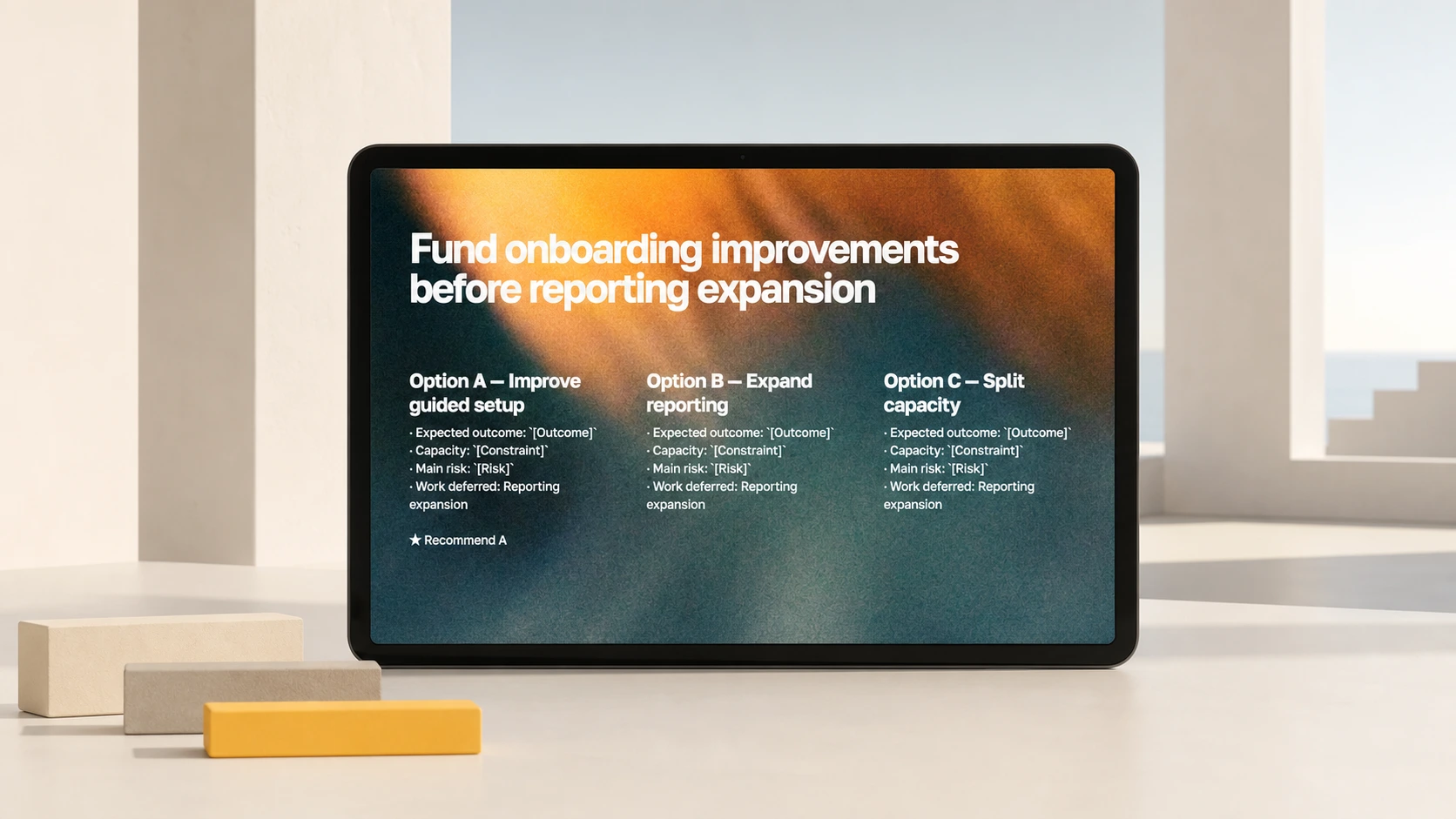
Put the conclusion in the title: “Fund onboarding improvements before reporting expansion.” Below it, show the required decision, planning horizon, and person accountable for the recommendation.
“Q3 Product Roadmap” makes readers wait for the point.
Slide 2: Connect the product goal to company strategy
Show one product goal, the company objective it supports, and the target user or customer group. Move the full strategy document to the appendix.
Company objective: Grow adoption in mid-market accounts
Product goal: Help account administrators complete setup with fewer support interventions
Planning question: Which onboarding problem should receive the next available team capacity?
This example is fictional. Replace each line with approved language from the company strategy.
Slide 3: Show the evidence behind the priority
Choose the evidence that changed or confirmed the team’s view: product data, research findings, support themes, or sales evidence. Name the source and period. Separate observation from interpretation.
| Observed | Team interpretation |
|---|---|
[Metric] changed from [A] to [B] during [period] |
[Problem] now limits progress toward [goal] |
[Number] of [research participants] encountered [issue] |
The team should test [proposed response] before expanding scope |
The placeholders prevent sample material from looking like company data. Replace them with evidence the team can defend in the room.
Slide 4: Explain the prioritization rule
Show how the team compared opportunities. Use criteria the organization already accepts, such as contribution to the goal, evidence strength, cost, risk, or strategic fit. Add a scoring model only if the meeting must approve it.
We prioritized work that addresses the setup bottleneck, has direct research support, and fits the available product and engineering capacity.
Slide 5: Compare credible options and their costs
Include only paths the team could take and use the same fields for each one.
| Option | Expected outcome | Capacity or dependency | Main risk | Work deferred |
|---|---|---|---|---|
| A: Improve guided setup | [Outcome] |
[Constraint] |
[Risk] |
Reporting expansion |
| B: Expand reporting | [Outcome] |
[Constraint] |
[Risk] |
Guided setup |
| C: Split capacity | [Outcome] |
[Constraint] |
Slower learning on both bets | Deeper work in both areas |
A decoy option makes the recommendation look manipulated and invites debate about the process.
Slide 6: Present outcomes and bets across horizons
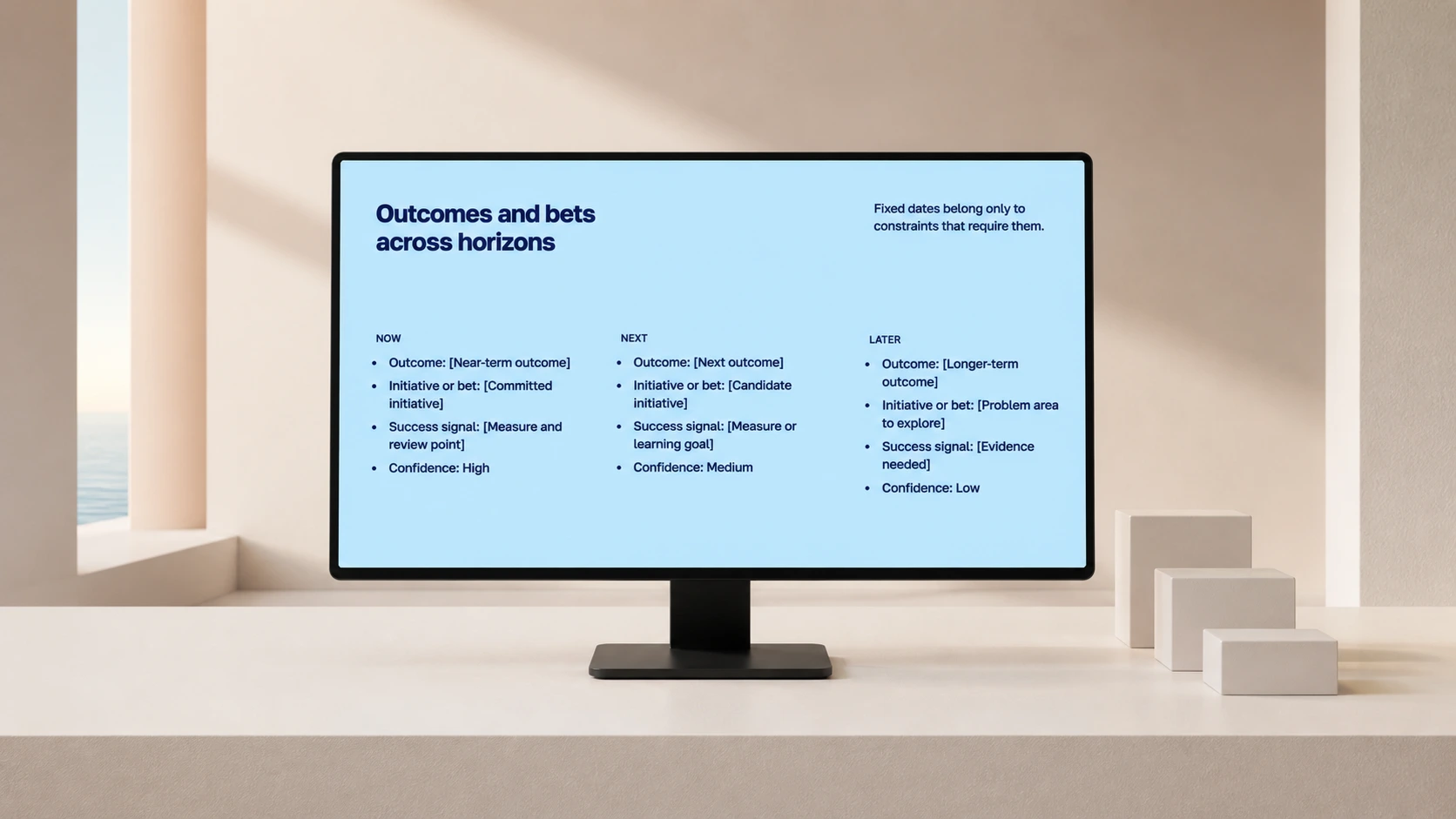
Now, Next, Later suits work whose exact dates would overstate certainty. Atlassian recommends broad units such as months or quarters and suggests Now, Next, Later to keep discussions focused on goals and strategy. Its agile roadmap guidance describes a roadmap as a plan that changes with conditions.
| Horizon | Outcome | Initiative or bet | Success signal | Confidence |
|---|---|---|---|---|
| Now | [Near-term outcome] |
[Committed initiative] |
[Measure and review point] |
High |
| Next | [Next outcome] |
[Candidate initiative] |
[Measure or learning goal] |
Medium |
| Later | [Longer-term outcome] |
[Problem area to explore] |
[Evidence needed] |
Low |
Identical visual treatment makes every horizon look equally committed. Use dates when contracts, regulation, launches, or dependencies require them, and name the source of each constraint.
Slide 7: Make the exclusions explicit
List the work the recommendation postpones or removes. Include the reason and condition for reconsidering it.
| Not now | Reason | Revisit when |
|---|---|---|
| Reporting expansion | Capacity moves to onboarding goal | Setup experiment reaches its review point |
| Secondary segment support | Evidence for primary segment is stronger | Research closes the named evidence gap |
Leaders can then dispute the consequence directly instead of adding work without removing anything.
Slide 8: Show delivery logic at roadmap level
Include dependencies and capacity assumptions that could change the decision. Keep sprint tasks, ticket counts, and team-level sequencing in an appendix or linked delivery plan.
Complete problem validation → test the riskiest assumption → review the success signal → expand, revise, or stop the initiative
Name the owner of each external dependency. “Identity team must expose the account-status API before the pilot” is actionable; “engineering dependency” is not.
Slide 9: Define measures and review triggers
Explain how the team will decide whether to continue, change, or stop each near-term bet:
- Outcome measure:
[Metric tied to the product goal] - Guardrail:
[Metric the team should not damage] - Evidence date:
[When enough evidence should exist] - Review trigger:
[Threshold or finding that forces reconsideration] - Decision owner:
[Role or named person]
Use thresholds only after the team approves them. Otherwise, state the question the review must answer.
Slide 10: Close with decisions, owners, and next dates
Repeat the requested decision. Record each follow-up decision, its owner, and due date so the final slide can serve as the meeting record. Keep it visible during discussion instead of switching to a generic “Questions?” slide.
Adapt the same roadmap data to the conversation
ProductPlan’s guidance on sharing roadmaps recommends tailoring the view to the audience rather than reusing one presentation for every stakeholder group. These examples are fictional and do not claim real results.
Executive portfolio review
Slide title: “Allocate the next team slot to onboarding; reporting moves to the following review.”
Show the company objective, expected outcome, capacity choice, main risk, and deferred initiative. Leave feature detail in the appendix. Leaders need to discuss resource allocation and strategic fit.
Product and engineering review
Slide title: “Validate account permissions before building the guided setup flow.”
Show the assumption, discovery work, technical dependency, evidence needed, and branch after review. This group needs enough delivery logic to challenge feasibility and sequence.
Go-to-market alignment
Slide title: “Position the onboarding pilot as a learning release for one customer segment.”
Show the target segment, customer problem, scope boundary, feedback route, and claims the teams should avoid. The group needs a shared account of what the release supports and what remains premature.
Adapt the framework for a project roadmap presentation
A project roadmap centers on a defined delivery objective, milestones, dependencies, and risks. A product roadmap centers on outcomes, strategic choices, and evidence that may change the plan. Some initiatives need both views.
| Product view | Project view |
|---|---|
| Outcome and customer problem | Deliverable and acceptance condition |
| Bet or initiative | Workstream or milestone |
| Evidence and confidence | Status and forecast |
| Review trigger | Dependency and deadline |
| Deferred opportunity | Out-of-scope deliverable |
An identity migration, for example, may have a project roadmap for vendor selection, data migration, and cutover. Its product roadmap should explain the user or business outcome behind the work and the product investment that loses capacity. Leaders can then review execution without losing sight of the strategic choice that authorized it.
Remove five failure modes before the meeting
A decorative timeline with no argument
Dates and colored bars show sequence. Add the selected initiative, intended outcome, evidence, trade-off, and confidence.
A feature inventory presented as strategy
A long feature list invites line-item negotiation. Group work under outcomes or strategic themes and keep feature detail available for questions.
Precision the team cannot support
A distant date can turn an assumption into a perceived commitment. Use broad horizons for uncertain work and label fixed dates with the constraint behind them.
Priorities without exclusions
If every request remains, the deck shows demand rather than priority. Add deferred work and the conditions for reconsidering it.
One deck for every audience
Executives, delivery teams, and go-to-market partners make different decisions. Keep one source roadmap, then adjust the presentation’s depth and emphasis for each meeting.
Turn the roadmap narrative into an editable deck
Draft the argument before working on layout: decision, evidence, credible options, recommendation, roadmap horizons, exclusions, and review triggers. Ask a colleague to read it. They should be able to identify the requested choice and its cost without interpreting a timeline graphic.
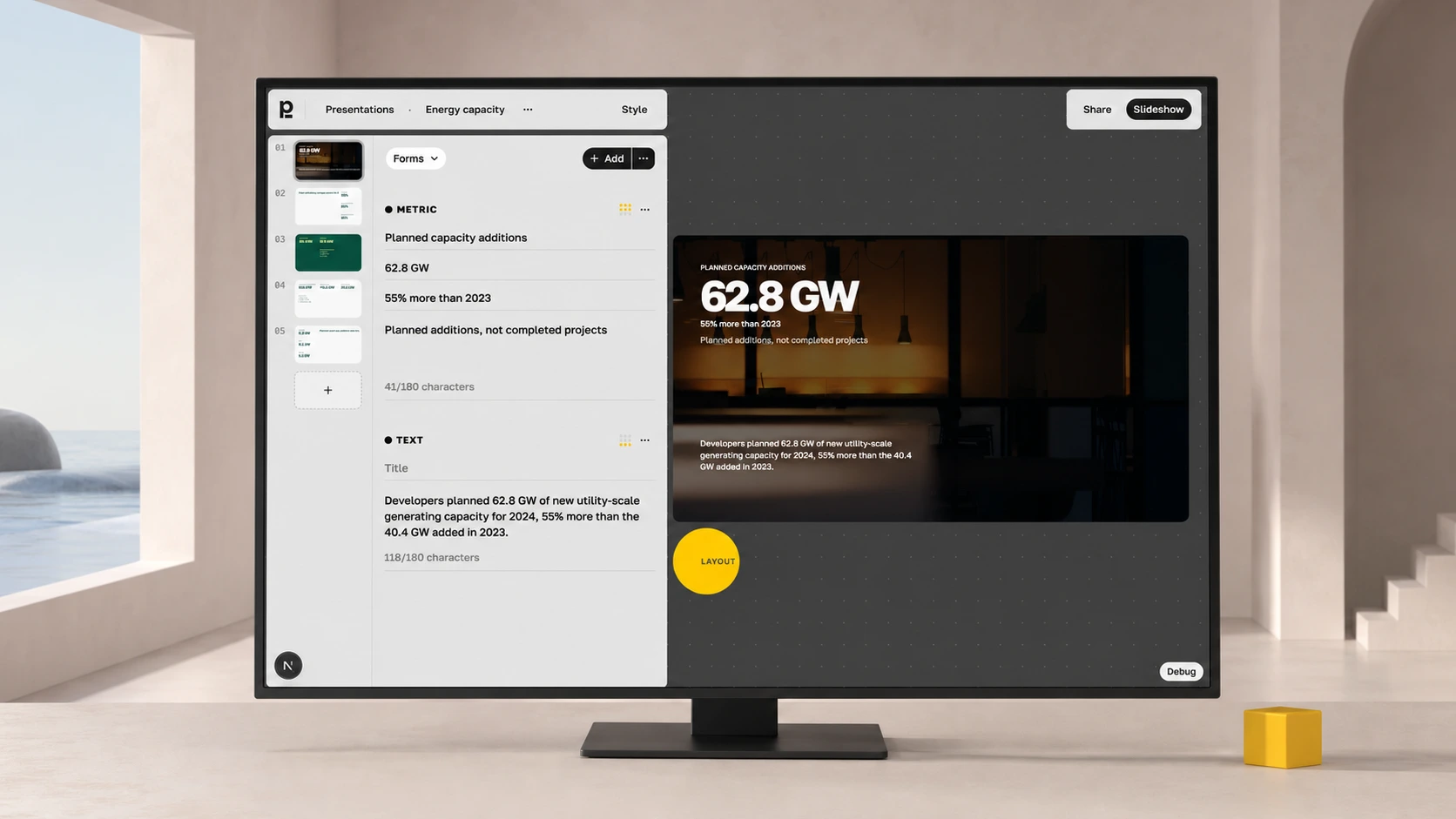
You can build the slides by hand in any presentation editor, following the same route as turning text into a presentation. If the narrative already exists in a memo, report, or outline, Plainline can split it into slides and identify claims, evidence, numbers, and conclusions. The team can edit the content, semantic blocks, layout variants, and media before sharing or exporting the deck.
When the roadmap review turns into a funding request, switch to the business proposal structure. Plainline assembles the deck; the product team owns the strategy, evidence, and recommendation. After conversion, check each slide against the decision named at the start.
Frequently asked questions
What should a product roadmap presentation contain?
A decision request, the product goal and the company objective it serves, the evidence behind the priority, the prioritization rule, the credible alternatives, the bets across horizons, the explicit exclusions, the delivery constraints, the measures and review triggers, and the owners with dates. The timeline supports that argument rather than replacing it.
Should a roadmap presentation use dates or Now, Next, Later?
Use exact dates only where the team can commit to them, usually the nearest horizon. For later work, broad horizons such as Now, Next, and Later state sequence without implying a precision the team cannot support. A date the team will miss costs more credibility than a horizon label.
How do I show what the team is not building?
Give exclusions their own slide. List the postponed work, the reason it was postponed, and the condition that would bring it back. Without that slide, every stakeholder assumes their request is still somewhere in the plan, and the disagreement surfaces after the roadmap has been approved.
How many slides should a roadmap presentation have?
About ten for a leadership review, with sprint-level detail, full research, and financial models moved to an appendix. Adapt the same underlying data for other audiences: an executive portfolio review, a product and engineering review, and a go-to-market alignment need different depth, not different roadmaps.
Sources
- Developing a roadmap — GOV.UK Service Manual
- Product roadmaps — Atlassian
- How to share your product roadmap — ProductPlan